Before planning a workshop, I decided to set up a meeting with Gemma Reed to discuss outreach workshops and what is required in order to obtain funding from an institution, in this case the Institute of Physics. I would still like to base the subject of the workshop on Supernovae. Gemma talked me through an outline regarding Public Engagement, suggesting that the place to start is with why you want to do public engagement and who is your target audience?
Following my discussion with Professor Newsam, we had talked about modes of engagement: due to my poor teaching in physics at Secondary School and discovery of it through my art practice, I feel as though there is a missed opportunity at schools for a creative approach to science. I had always thrived in creative subjects at school but especially struggled with focus in academic subjects in part due to my dyslexia. I believe that had the curriculum been more flexible and accessible to different learning styles, particularly those with Learning Differences, I and many other pupils would have learnt more and been engaged at an earlier age in the sciences. My initial plan was to go to secondary schools to do a workshop on this creative approach, however both Professor Newsam and Gemma Reed have suggested primary school as the timetable has more flexibility. On top of that, primary pupils may show more engagement.
Since I had both my target audience and reason for outreach, Gemma went through the structure in consideration of learning age: the presentation on the introduction into Supernova should be no longer than 10 minutes, otherwise pupils will quickly get bored, the main bulk of the session should be activities. Any materials used for the creative activity in the workshop should be laid out on individual trays that can then be handed out once the activity begins. The feedback will also work differently with children who may be at different literacy ages, so alternative approaches like a yes-no spectrum should be used in this case with both verbal and written questions. I suggested using stickers since children love them.
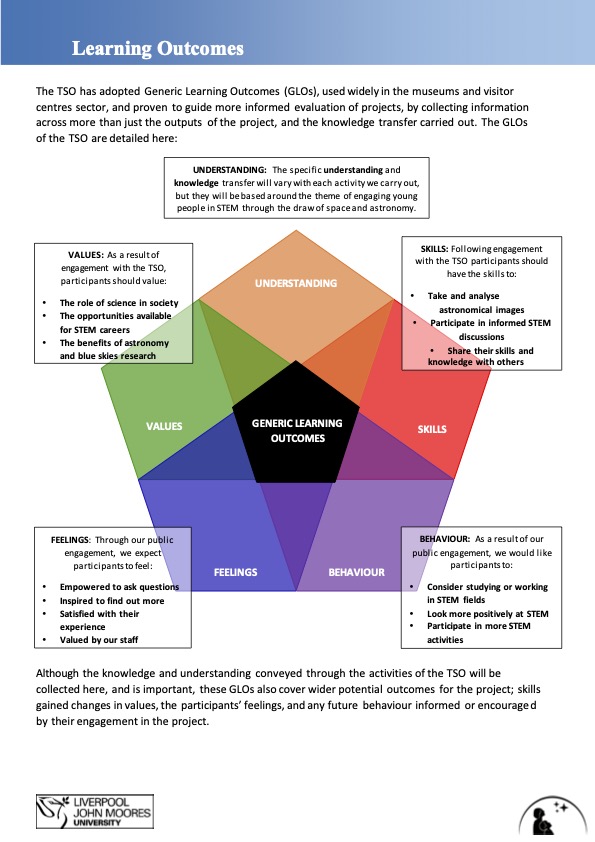
Gemma gave me plenty to think about in terms of planning, as well as, research for science-based outreach from the School’s Observatory, Institute of Physics and Science Museum websites, all of which have detailed outlines and potential learning outcomes I can follow. My next step is to work through the outreach planning form.
 Orla Fox
Leave a comment