How did a mathematician, Ibn Al-Haytham, from the Islamic Golden age influence contemporary sci-fi storytelling and our perception of time?
With the release of the new sci-fi epic Project Hail Mary (Lord and Miller, 2026) the debate about the scientific aspects of the film have already begun. The New York Times review headlines: ‘A Hail Mary for Earth based on Solid Science’, while Jonathan Romney in the Financial Times calls it a ‘space caper’. Project Hail Mary is based on the novel by Andy Weir. Weir is also the author of The Martian, which was filmed to great acclaim and box office success by Ridley Scott in 2015.
The science behind the Sci-fi
As a non-scientist but with a deep interest in astrophysics, which figures heavily in my artistic practice, I am aware that science fiction film and literature often extrapolate beyond the proven. However, what these examples of sci-fi storytelling do is to take scientific theories and help the audience approach them through a compelling narrative. But what if the fundamental physics behind these films have far more ancient origins? A Millennium before modern physics, 11th Century Scholar Ibn al-Haytham through his meticulous study of light, anticipated Fermat’s Principle of Least Time, a discovery which would alter our notion of both Light and Time.
Visualising time in Arrival and Interstellar
Two enthralling sci-fi films that challenge and entertain audiences with astrophysical phenomena, particularly in the subject of Time, are Interstellar (Nolan, 2012) and Arrival (Villeneuve, 2016). Both films use the magic of film storytelling to show how time and memory can be visualised in a higher dimension, while maintaining their entertainment factor. What appears to be speculative fiction is based on centuries old scientific thought with Ibn al-Haytham’s story central to its development.
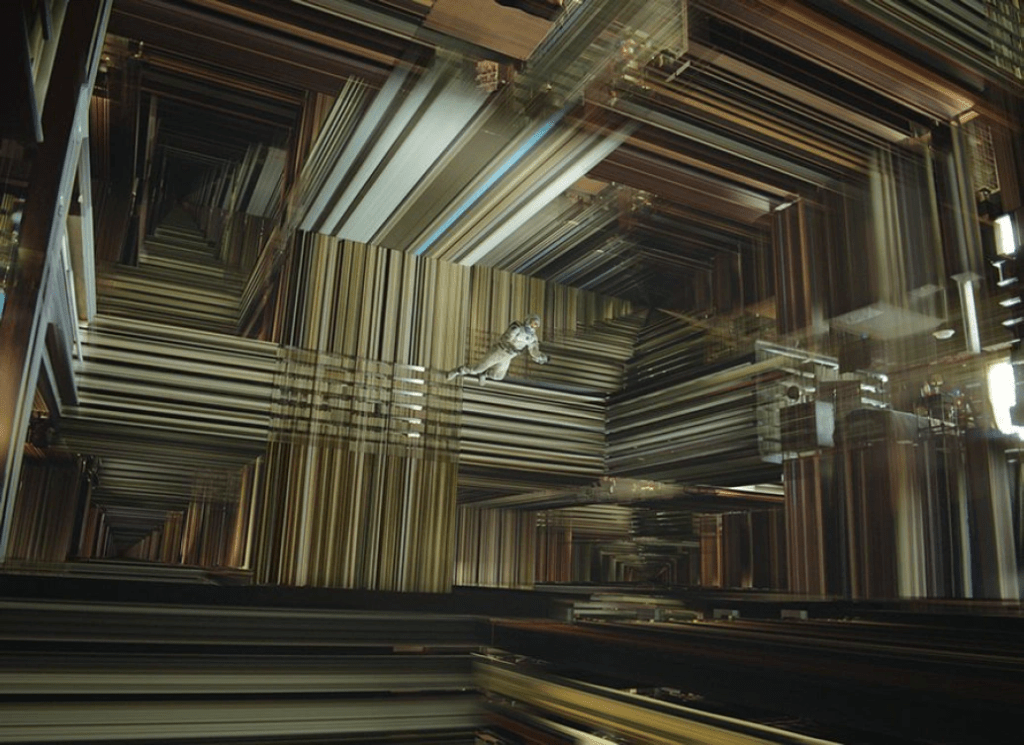
Interstellar, transforms established scientific hypothesis into entertainment through narrative, cinematography and production design, visualising the complexities of relativity, making it accessible to a mass audience. The tesseract scene does this best, representing the extended dimensions of spacetime, while pulling in the audience through the emotional connection between Cooper (Matthew McConaughey) and his daughter Murph (played by three different actors at different stages of her life, Mackenzie Foy, young Murph, Jesscia Chastain, adult Murph, Ellen Burstyn, elderly Murph) a love that transcends space and time.
It was when watching Arrival, a film about an alien arrival on Earth, that I first became aware of Fermat’s Principle of Least Time, a fundamental theory on optics and refraction. I have used this Principle as a jumping off point in several of my artworks to explore – considering mass and energy are one in the same – whether ink can hold the same principle as light does and know its own path (see Fermat’s Principle in Ink). As suggested in Fermat’s Principle of Least time, can light theoretically “open time”?
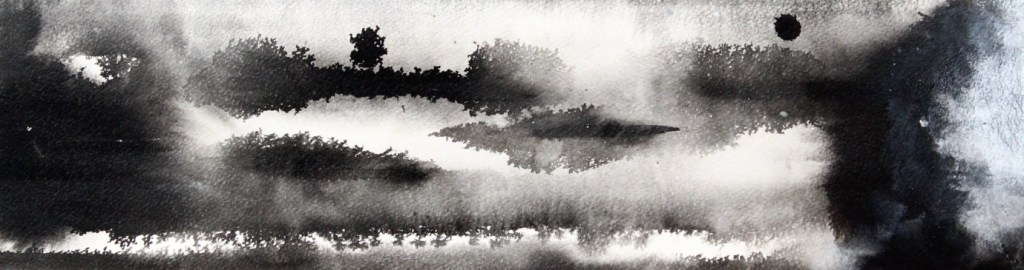
Arrival, is underpinned by Fermat’s Principle of Least Time and like Interstellar, reconsiders the two-dimensional nature of time. Louise (Amy Adams), a linguist, is tasked with communicating with the extraterrestrials to discover ‘What is your purpose?’ The aliens communicate through logograms, created through secretions of ink, like that of a squid, the orthography is circular, with no beginning or end, time does not appear to exist in a sequential manner according to the alien language.
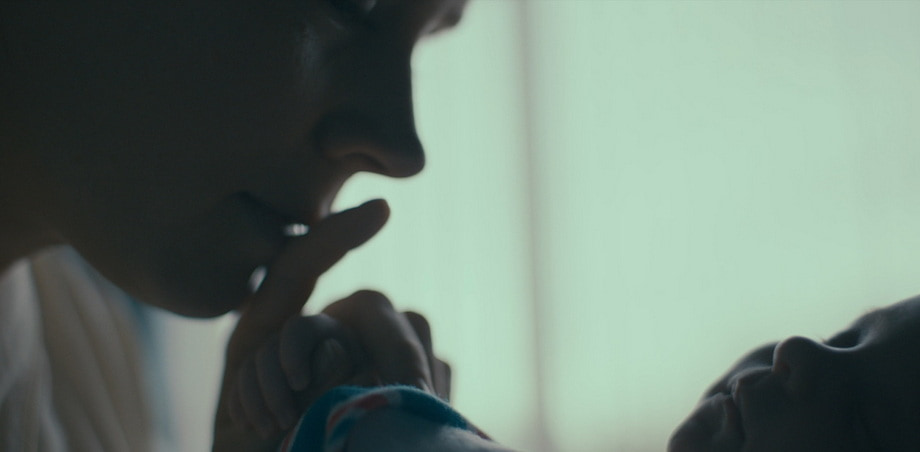
In the climax of the film we discover the narrative’s structural linearity is an illusion as Louise gains knowledge of the future through communication with the aliens. Louise’s acquisition of the language allows her to “open time” and by doing so experience future memories, this becomes analogous of Fermat’s Principle.
Fermat’s Principle: Uncovering the science behind the story
The film Arrival is an adaptation of the Ted Chiang novella Story of Your Life (1998) inspired by Fermat’s Principle of least time. Fermat’s Principle suggests that: Light will take the path that requires least time, meaning that light will alter its trajectory when it hits water, with the knowledge that it will travel slower than it would in air. This suggests that light knows its endgame. Chiang’s aliens (known as Heptapods) embody this theory and act to change the future with the knowledge it is predetermined, like that of light it takes the path of least time.
The face behind the theory: Ibn al-Haytham and the birth of optics
Flashback in true cinematic fashion to the 11th century and the writings of Ibn al-Haytham (965-1047) an Astronomer and Mathematician of great renown whose work I became aware of in my research on optics and observation.
Based on historical accounts, Ibn al-Haytham got into a dispute with the Caliph of Egypt about dam building to ensure the Nile would not continually flood. To escape the Caliph’s wrath, Ibn al-Haytham feigned madness and in accordance with Islamic law was imprisoned rather than being executed.
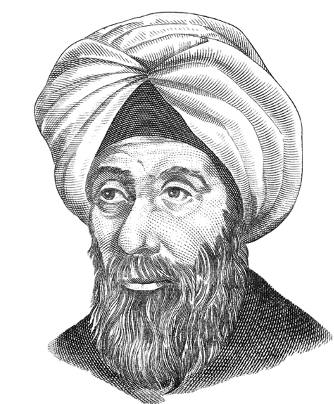
It was during this long period of confinement that Ibn al-Haytham spent his time meticulously studying light, how it travels, how our eyes see, but also developing a methodology very close to what we now consider to be the scientific method, experimentation as a way of proving a hypothesis. He is now considered the father of modern optics. The belief at the time was that the human eye perceives its surroundings through light or a kind of fire emanating from the eye itself, as Plato (428–423 BC, died 348/347 BC) writes:
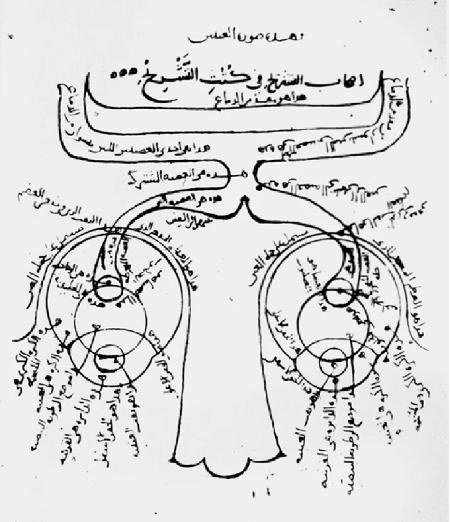
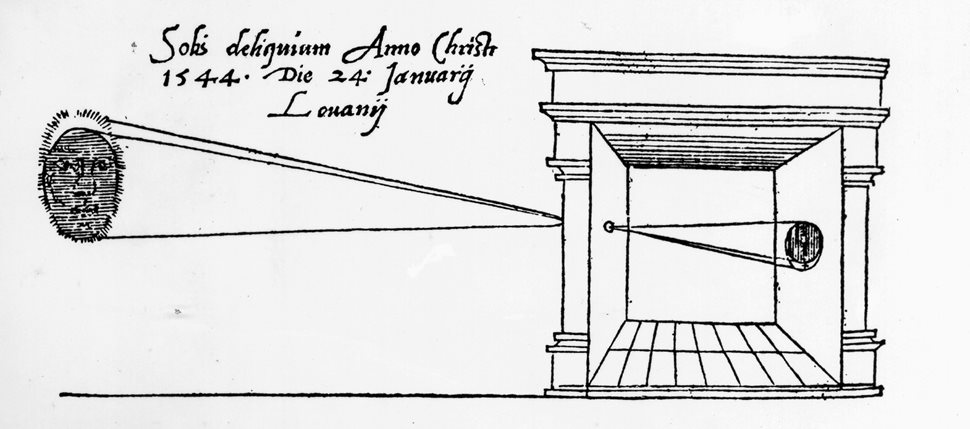
Ibn al-Haytham uncovered that light in fact travels in straight lines and that vision occurs when the light enters the eye rather than, as Plato suggested, emanating from the eye. In his confinement he also created one of the first recorded Camera Obscuras and through experimentation he concluded that light has a finite speed and that its speed alters when entering a denser medium. He went a further step by stating that: ‘the path assumed by a refracted ray … is always the one which is the easier and quicker’. Ibn al-Haytham anticipated Fermat’s principle six centuries before Fermat.
From 11th century to now: How the origins of optics led to modern science and speculative fiction
Light is a fundamental, it is so intertwined within our reality, we rarely stop to think what it is. We know where it comes from, but how does it determine our past and future? Light has a finite speed, it is the fastest thing in our Universe, we know this from thousands of years of research: from a pin prick in a darkened window, to the Large Hadron Collider established by CERN a 27km underground tunnel near Geneva, where the largest particle experiment in the world takes place to investigate the origins of matter.
The beginnings of Optics as set out by Ibn al-Haytham were low-fi, yet the discoveries that were made altered the course of history and our understanding of reality. In today’s contemporary culture, we know more about our Universe than ever, particularly through the tireless efforts of organisations like CERN, but how we tell visual stories about our Universe, often through science fiction cinema, makes the mystical, the fantastical and the scientific accessible to wider audiences.
As an art-science researcher and practitioner, I approach the complexities of astrophysical phenomena through visualising. Within my work, themes of astronomy and cosmology are transformed into artefacts, allowing scientific hypotheses to become tangible and therefore accessible to a wider audience. A great example of the power of the art in science relationship is The Arts at CERN residency where artists from across the globe are invited to create in response to CERN’s research. This initiative helps increase public engagement and visitor footfall to CERN but also as a publicly funded institution, public engagement and approval is integral. Although cinema exists in the commercial sphere, it is evident from the box office success of all three listed films that the audience’s desire for knowledge about science through art/entertainment is strong.
Why this still matters
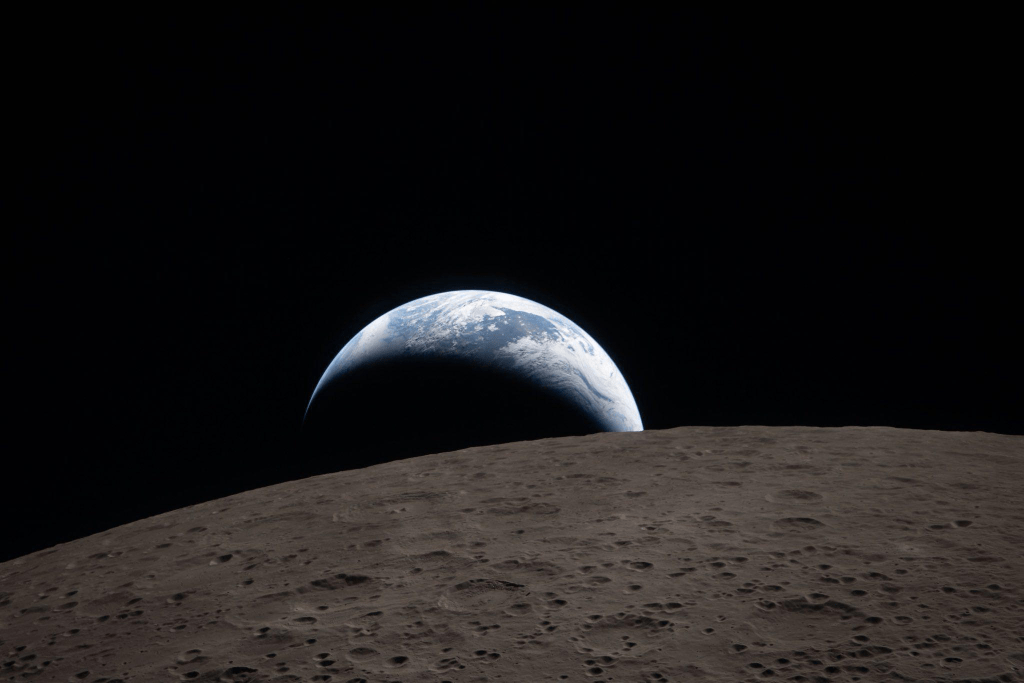
Leaving a cinema after viewing Arrival or Interstellar or indeed, Project Hail Mary, thinking about whether light can theoretically “open time” is a wonderful example of community outreach for the sciences. And to demonstrate how quickly this outreach has worked in the scientific community and beyond the communication between NASA control room in Houston and Artemis II astronauts used a line from Project Hail Mary in response to their extraordinary images of the dark side of the moon. “Amaze, Amaze, Amaze”.
Without Ibn al-Haytham there would be no Fermat’s Principle of least time, no Chiang’s The Story of our Life, no Arrival, no Interstellar. What one might call, cause and special effect.
: Internet Publication Orla Fox