Next Steps
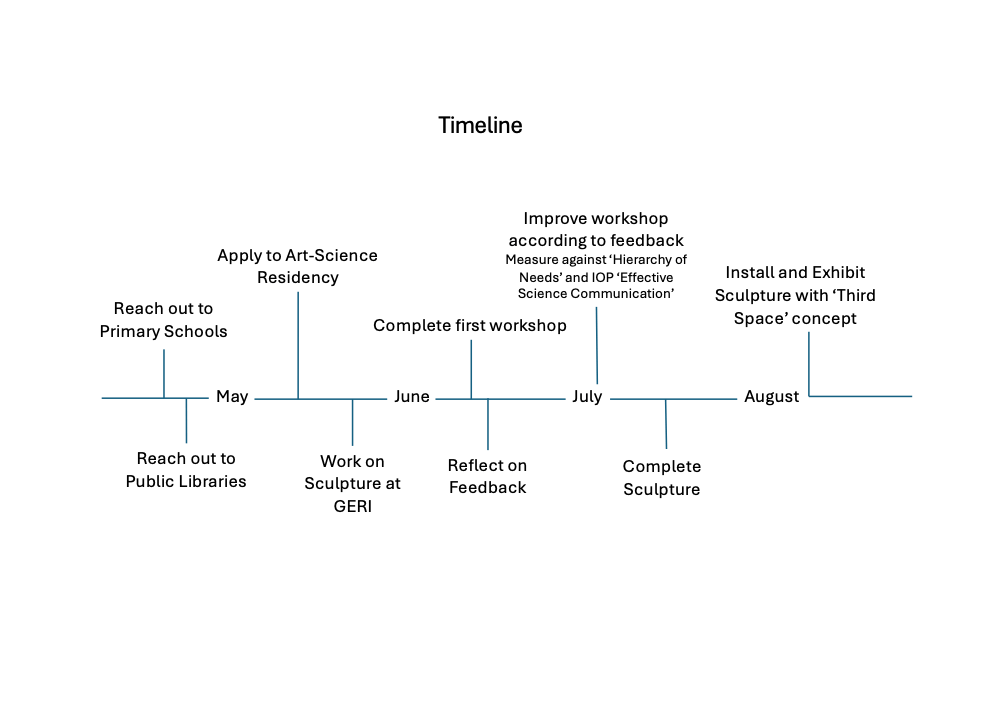
Thus far, the main activities of this project have been about planning, reaching out to people and researching; tangible results will follow. However, this module has enabled me to set in place a methodology to approach the next term which will result in a cumulative outcome. Now that the copper for my sculpture has been delivered to GERI, I can begin to work on my sculptural construction and delve into a new practice of metalwork and learn new skills.
The first step, when I complete the sculpture, before August, is to exhibit in the JLADB in a window opposite the ARI where there will be a telescope. This will extend this sculpture into an interactive exhibition and activate the Hidden Third (Nicolescu, 2014) through the participation of the observer. Though I do not plan to collect quantitative feedback from this participatory installation, I hope that this will facilitate a connection between the two buildings, encouraging each to break out of their institutional ‘silos’ to develop further transdisciplinary work.
Regarding my workshop, the next step is to reach out to primary schools through the School’s Observatory to seek permission to deliver my workshop. Professor Newsam suggested I also reach out to local libraries to host my workshop. When I complete the workshop, I will be able to assess against Gemma Reed’s ‘Hierarchy of Needs’ and the IOP’s ‘Effective Science Communication’. This data will come from my question yes/no spectrum, assessing whether the children learnt something new and if there has been a change in attitude, verbal feedback from the teacher and my own general reflection throughout. For example, whether the children were engaged? Did the creative approach facilitate learning? This will aid in the further improvement of my workshop and whether an interdisciplinary approach to science education is effective.
I will continue with my interdisciplinary approach to my practice by creating work related to astrophysical phenomena into the next term by working on the realisation of my metal sculpture, thereby gaining new skills from metal technicians and engineering specialists. In addition, I will apply for the Cavendish Arts Science residency, based at Girton College, Cambridge University. The residency is aimed at artists and facilitates Art-Science encounters. The Cavendish Laboratory is best known for its innovation in fundamental physics- exploring the universe at all scales. This residency, like Arts at CERN, places artists in a scientific space, facilitating an interdisciplinary crossover, where artists can produce work in response to the experiments at the Laboratory. The residency stood out to me, due to my natural interest in physics that manifests in my artwork but also the opportunity to work in a space that has fostered hundreds of years of scientific findings. Before sending my application, I will ask Professor Newsam’s advice, as an expert in science outreach, his insight will be incredibly beneficial, as I have found in this transdisciplinary project.
If I am successful in my application I believe I would thrive within a scientific environment. I found this to be the case with my previous residency at Goonhilly Satellite Station where I produced a sculptural installation based on radio waves. That residency facilitated my creative outcome, based on scientific theorems and boosted my confidence in communicating with experts, in their working space, as a non-expert. The Cavendish residency would expand my sculptural practice and enhance my interdisciplinary approach to creative practice.
 Orla Fox